

Big Data Analytics in Dubai Real Estate for Smarter Investing in 2026
Overview
Introduction
Think about how much data the Dubai real estate market creates every single day. Every sale, every rental contract, and every new project generates a stream of numbers. Between January and November 2025, the market recorded over 197,000 property transactions worth a massive AED 624 billion. That is a lot of information.
But here is the thing. Many professionals in this market still make big decisions based on intuition alone. They guess on pricing. They hope the timing is right. Without real time access to this data, buyers, sellers, and investors face a lot of uncertainty. You cannot rely on portal listings or just what one agent tells you. The real story lives inside official sources like the Dubai Land Department (DLD), RERA, and Ejari.
That is where big data in analytics changes the game. Simply put, data analytics in big data means using all this information to spot real patterns instead of guessing. It helps you understand supply and demand, track investor sentiment, and see where the market is really headed. Whether you are buying your first home or managing a large portfolio, understanding analytics & big data tools can remove the stress from your choices.
This article explains exactly how big data and analytics works in real estate, with a special focus on the Dubai market in 2026. We will look at the tools and methods that top investors use. We will also touch on how you can even earn a certification for data analytics if you want to master this skill.
If you are ready to move past guesswork and start using real data for your next move, you are in the right place.

Let us explore how seeing the full picture can help you invest with confidence.
What Is Big Data in Real Estate Analytics?
So what does big data in analytics actually mean when we talk about Dubai real estate? Think of it as every digital footprint left by the market. Every sale registered with the Dubai Land Department. Every rental contract recorded through Ejari. Every new off plan project filed with RERA. Each one is a data point. Now multiply that by thousands every day.
In simple terms, data analytics in big data is the process of collecting, organizing, and studying all that information to find real patterns. It is not just about having a giant spreadsheet. It is about using tools that can handle massive amounts of fast changing data. For real estate, that includes transaction prices, property features, neighborhood demographics, and even investor sentiment scraped from news and social media. The volume is huge. The speed is high. And the variety is wide.
Big data and analytics in this field focuses on three main parts:
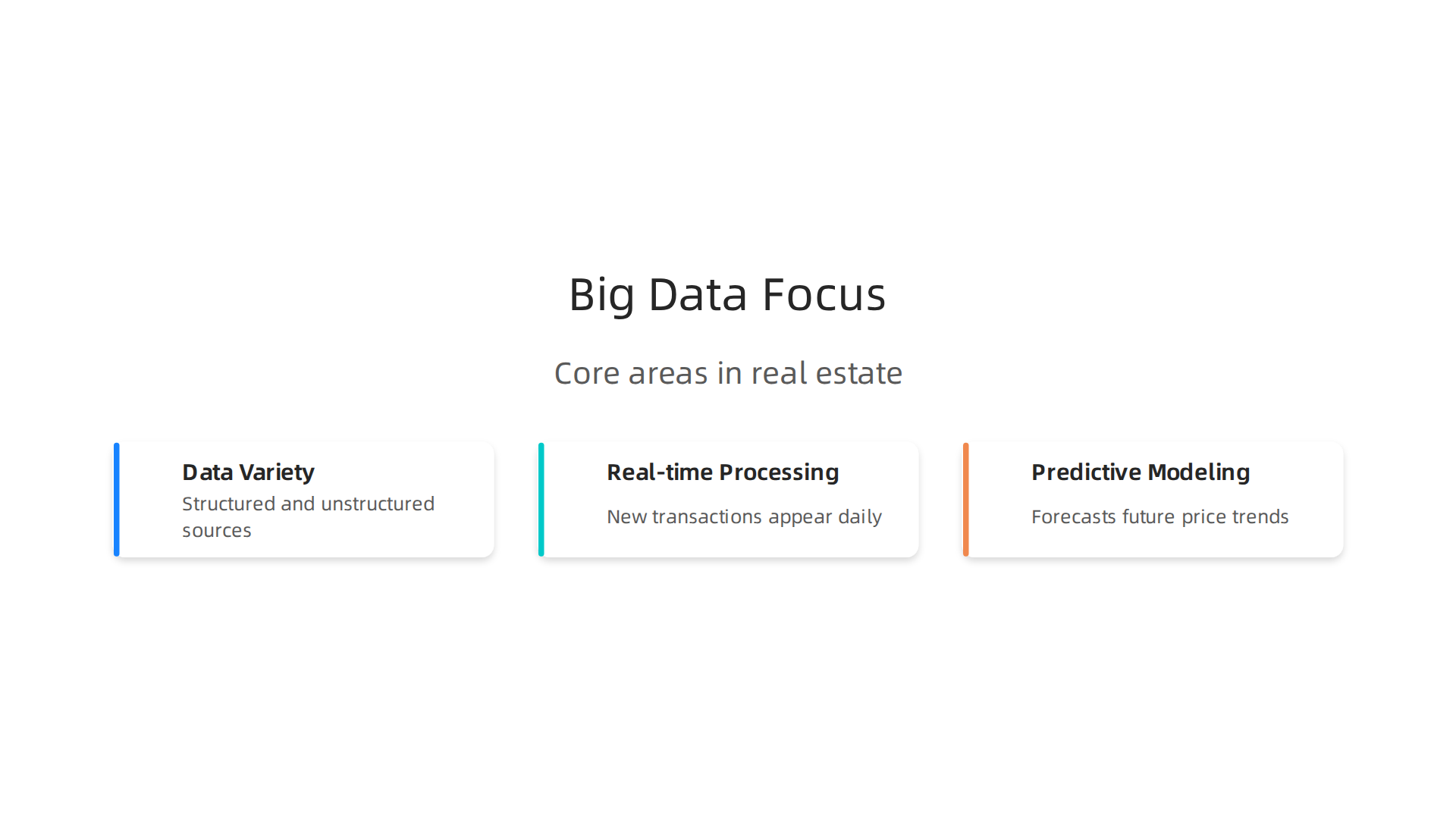
- Variety of data. You get structured numbers like sale prices and square footage. You also get unstructured data like agent comments, tenant reviews, and satellite images.
- Real time processing. New transactions appear daily. Platforms like REIDIN and Property Monitor update indices monthly, but raw data from the DLD comes out even faster.
- Predictive modeling. By looking at past cycles and current trends, algorithms can forecast where prices are heading next.
Now why does this matter so much for Dubai? The city is a global hub. It has free zones with unique property rules. It has a massive expatriate population that moves in and out. Tourism flows bring short term rental demand. All of this creates a complex data set that no single portal can capture. The official sources DLD, RERA, and Ejari are the only trusted starting points, as experts recommend using registered transactions, not listing websites.
In 2025 alone, over 197,000 transactions worth AED 624 billion were recorded. That is the kind of volume that calls for analytics & big data tools. If you want to dig deeper into how to use this information for your own investments, check out this data driven guide on market cycles. And if you are curious about learning the skills, there are even free resources for a certification for data analytics tailored to real estate.
Understanding what big data is on paper is one thing. The real power comes from using it to make smarter choices.

Key Data Sources in Dubai’s Real Estate Ecosystem
To make big data in analytics work for you, you first need to know where the raw numbers come from. In Dubai, data flows from three main layers:
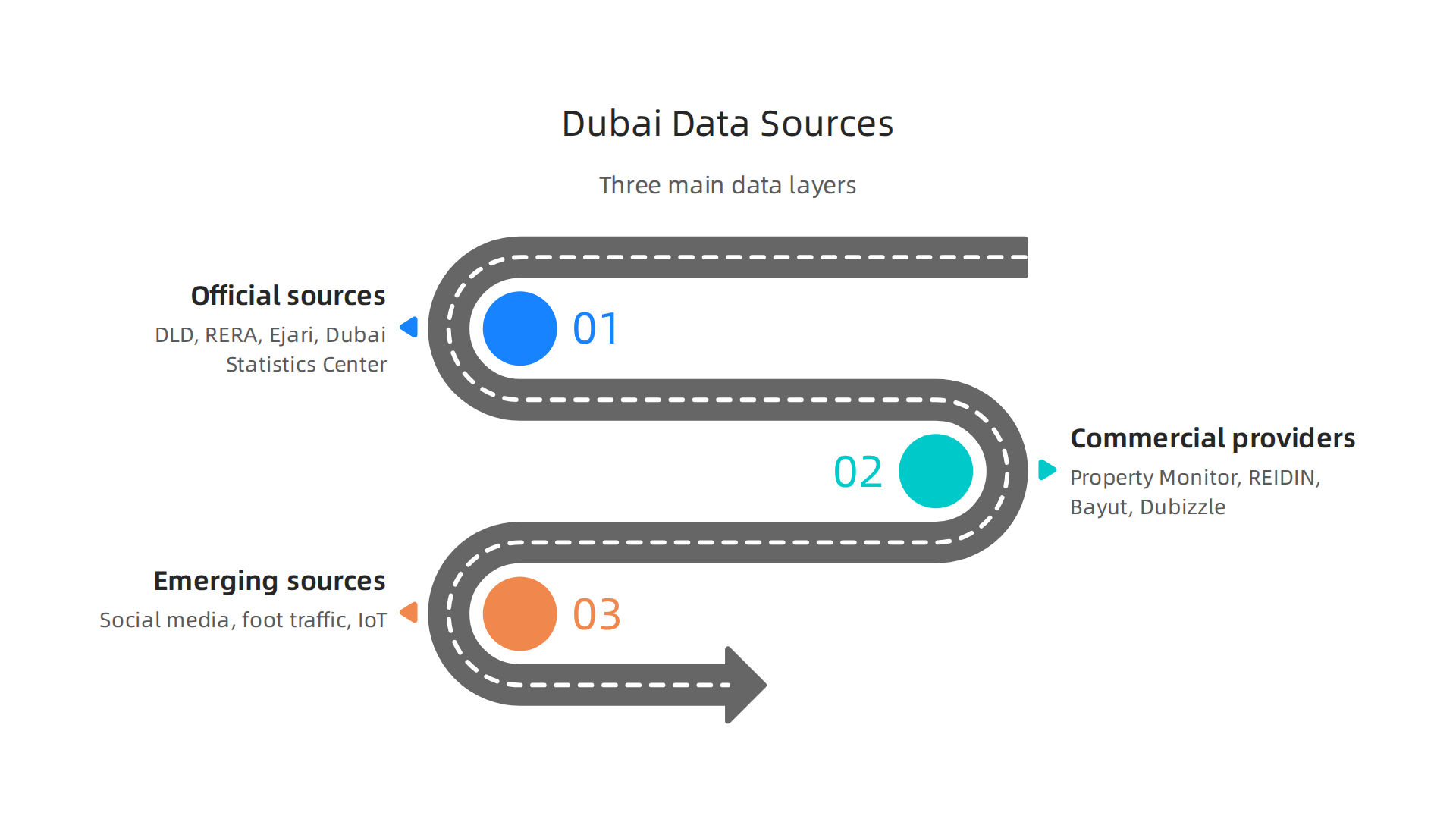
1. Official sources. This is the foundation. The Dubai Land Department (DLD), RERA, and Ejari register every legal transaction and rental contract. As experts point out, you should always use registered transaction data, not listing portals, to get accurate prices. The Dubai Statistics Center also provides demographic and economic reports that feed into data analytics in big data models.
2. Commercial providers. These platforms take official data and package it into digestible reports and indices.
- Property Monitor publishes monthly market reports with price trends.
- REIDIN releases residential price indices that industry analysts rely on for quarterly overviews.
- Listing portals like Bayut and Dubizzle give you current asking prices and inventory trends.
3. Emerging sources. Newer data streams are adding depth to big data and analytics. Social media sentiment analysis tracks how investors feel about certain areas. Foot traffic data from mobile phones shows which neighborhoods are busiest. IoT sensors in smart buildings measure energy use and occupancy patterns.
Want to explore how to layer these sources for smarter decisions? Check out our step by step guide on using analytics & big data to invest in Dubai real estate. And if you are just starting out, a free certification for data analytics can help you learn the fundamentals.
How Big Data Transforms Property Valuation and Market Timing
Imagine you are thinking about buying a flat in Dubai Marina. A real estate agent tells you it is worth AED 1.2 million. But how do you know that number is right? In the past, you had to trust one person’s opinion or compare a handful of similar listings. Now, thanks to big data in analytics, you can get a much sharper answer.
Old way vs. new way: Automated Valuation Models
Traditional valuation relies on a human appraiser visiting the property, checking a few recent sales, and making a judgment call. That works, but it is slow and can miss wider market shifts. Enter Automated Valuation Models, or AVMs. These are machine learning algorithms that crunch thousands of data points in seconds. They look at registered transaction prices, property features, neighborhood trends, and even economic indicators. As research from 2026 shows, AVMs use multimodal data like images and text to refine estimates too.
In Dubai, where over 197,000 transactions happened in just the first 11 months of 2025, AVMs give you a data-driven price that updates constantly. Instead of a single guess, you get a range backed by data analytics in big data. That takes the gut feeling out of negotiation and helps you avoid overpaying.
Tracking the market cycle with big data
Knowing a property’s value today is only half the story. You also need to know where the market is heading. Big data and analytics lets you spot supply-demand shifts early. For example, the Dubai Land Department and REIDIN publish monthly residential price indices. In early 2026, those indices showed rental growth slowing after years of double-digit increases. That is a leading signal that the market might be cooling.
You can also track new project launches, visa policy changes, and population growth through the same data streams. When supply starts to outrun demand, prices tend to flatten or drop. When demand surges, values rise. Using analytics & big data, you can see these patterns weeks or months before they hit the news.
Real-time timing for buying, selling, or holding
Here is the real payoff. With real-time data, you can time your move more precisely. Say you own a villa in Palm Jumeirah. Property Monitor’s monthly reports show transaction volumes slowing and average prices dipping slightly. That might be a sign to sell now before a bigger correction. On the flip side, if you see a neighborhood where transaction counts are climbing and days-on-market are shrinking, it could be a good time to buy before prices spike.
This kind of market timing was once reserved for big institutions. Now, individual investors can access the same signals through free or low-cost platforms.

If you want to learn how to layer these tools yourself, check out our step by step guide on using analytics & big data to invest in Dubai real estate. It walks you through exactly how to read property cycles and make smarter buy-or-sell decisions.
Bottom line: Big data turns property valuation and market timing from an art into a science. You no longer have to guess.
Predicting Price Movements with Machine Learning
Now, AVMs are great for a snapshot. But what if you want to see where prices are heading in the next three to six months? That is where machine learning (ML) steps up. ML models go beyond simple averages. They learn complex patterns from big data in analytics to predict future trends.
Here is how it works. You feed the model years of historical transactions. It learns non-linear relationships. It does not just say "bigger homes cost more." It understands that a two-bedroom apartment near a new metro station in JLT might rise faster than a similar one in a less connected area. The model looks at dozens of features: exact location, property type, square footage, proximity to schools and parks, and even macro factors like interest rates or visa changes. Recent research shows that multimodal ML models combining text, images, and numbers achieve even better accuracy for property appraisal.
A Dubai-specific model trained on local data can spot subtle trends. For example, it might detect that transaction volumes in a certain community are climbing while average price per square foot is still flat. That often signals a price jump in the coming months. Using data analytics in big data, you can act on these signals before the crowd.
If you want to start using these tools yourself, our guide on analytics & big data for Dubai real estate walks you through the exact steps. It shows you how to layer ML predictions with your own market research.
Predicting price movements with ML is not magic. It is just smarter math applied to the same big data and analytics that transforms everything else in real estate.
Rental Market Trends and Tenant Behavior Analysis Using Big Data
You just learned how machine learning predicts sale prices. But what if you are a landlord or a tenant? The rental market moves on its own rhythm, and big data in analytics is the key to understanding it.
Dubai’s rental sector is one of the most dynamic in the world. AI-powered platforms now bring transparency to this fast-moving space, as the GoDubai Portal explains.

With the right data, you can see exactly what is happening in your neighborhood.
What big data reveals about rental trends
Traditional rental reports give you one number for an entire community like Marina or JLT. But big data breaks that down further. It shows micro-neighborhoods. The east side of a community might rent 15% higher than the west side because of better views or quieter streets.
Big data also reveals seasonality. In Dubai, demand peaks in certain months. Families want to move before the school year starts. Professionals arrive in September and October after summer breaks. Models that use years of transaction data can predict these waves with surprising accuracy. The heterogeneous nature of Dubai’s data sources makes this analysis powerful, as noted in a thesis on rental property demand analysis.
Understanding tenant behavior
Here is where things get interesting. Big data and analytics track patterns that human agents might miss.
- Lease lengths: Some communities see mostly one-year leases. Others have tenants who renew for three or five years. This tells you about stability.
- Renewal rates: A high renewal rate means tenants are happy and the area is stable. A low rate might signal problems like rising rents or poor maintenance.
- Nationality-based preferences: Different groups prefer different areas. European expats might favor the Greens. South Asian families often choose International City or Al Nahda. Analytics & big data systems spot these clusters and predict where demand will grow next.
The Dubai Land Department recently highlighted that the rental market is stable, driven by an integrated regulatory environment. That stability makes data patterns even more reliable.
Who benefits from this data?
- Landlords: You can set the right price from day one. No more guessing whether you undersold or priced yourself out of the market. Analytics & big data tools help you optimize pricing for each unit.
- Tenants: You can find fair market rates. Instead of trusting a single listing price, you can see what similar units actually rented for. This gives you real leverage during negotiations.
- Investors: You can identify yield hotspots. A community with rising renewal rates and short vacancy periods is a cash flow machine. Data analytics in big data pinpoints these opportunities before the crowd notices.
If you want to dive deeper into using data for your own rental decisions, check out our guide on big data analytics in Dubai real estate. It walks you through the exact metrics to track.
The rental market does not have to be a mystery anymore. With certification for data analytics or just a willingness to learn, you can see the trends that others miss. That is the power of big data in analytics applied to real world decisions.
Investment Decision‑Making with Predictive Analytics
So you understand rental trends now. But here is the real question. How do you actually decide where to put your money in 2026?
Traditional investing in Dubai real estate often came down to gut feeling. You visited a few buildings. You talked to a broker. You maybe checked some historical prices. That approach is risky in a market where new communities emerge and old ones shift value fast.
Predictive analytics changes everything. It turns investing from a guessing game into a data driven science. The AI in real estate market is now valued at over USD 400 billion in 2026, and it is projected to grow fast. That growth is happening because these tools work.
Risk assessment with big data models
Every property carries risk. But how do you measure it?
Big data in analytics models can evaluate risk at two levels. First, they look at the property itself. How has this specific building or unit performed historically? What is the volatility in its sale prices? Second, they assess your whole portfolio. Are you too concentrated in one community or one price bracket?
These models use thousands of data points. They look at transaction history, vacancy rates, maintenance costs, and even surrounding infrastructure changes. The result is a risk score that helps you avoid bad deals. As one research paper on automated valuation models explains, these systems can now provide both prediction accuracy and uncertainty quantification. That means you know not just the expected return but also how confident the model is in that number.
Finding hidden opportunities
Here is where predictive analytics shines brightest. It finds opportunities that human eyes miss.
Algorithms scan every community in Dubai. They identify areas that are undervalued compared to similar neighborhoods. Maybe a new metro station is coming. Maybe a school is being built. The data catches these signals before they show up in prices.
This is especially powerful for off plan projects. You can analyze past performance of similar launches. Which developers delivered on time? Which communities appreciated fastest after handover? Data analytics in big data systems compare hundreds of variables to spot the next hot area.
Sentiment analysis for market timing
Numbers are not everything. Sometimes what people say matters more.
Advanced systems now use sentiment analysis. They mine news articles, social media posts, and expert reports. They look for positive or negative language about specific communities, developers, or the market overall.
For example, if negative news hits about a particular area, the sentiment score drops. You might want to wait before buying there. If sentiment is rising across the board, it might be time to act. The analytics & big data approach gives you this emotional temperature check automatically.
Putting it all together
The best investors in 2026 do not rely on one tool. They combine risk assessment, opportunity scanning, and sentiment analysis into one decision framework.
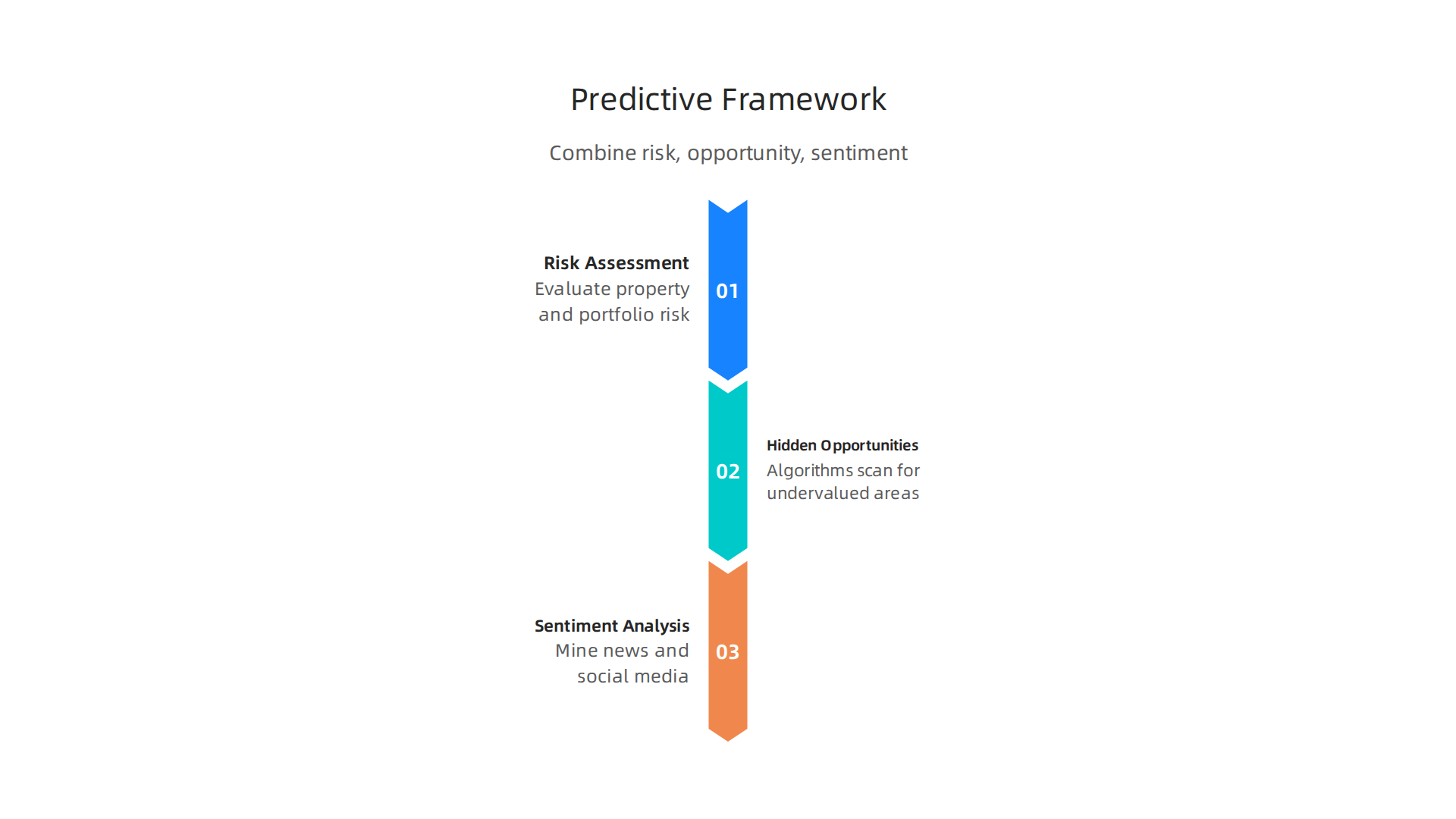
Start with the data. Use predictive models to screen properties. Check your risk exposure. Then validate with sentiment signals. If the numbers and the sentiment both say positive, you have a high conviction buy.

If you want to build these skills yourself, consider our detailed guide on big data analytics in Dubai real estate. It walks through the exact metrics to track and tools to use.
The market rewards those who use better information. Do not invest blind in 2026. Let data lead your decisions.
Challenges and Data Quality in Dubai’s Big Data Landscape
You have learned how powerful predictive analytics can be. But here is the reality check. Using big data in analytics is not as simple as flipping a switch. Dubai’s real estate market is complex. The data itself comes with real challenges. If you do not understand them, your decisions can be flawed.
Data fragmentation: silos everywhere
One of the biggest problems is fragmentation. Data lives in different places. Government agencies hold rental and transaction records. Real estate portals show listings. Developers keep their own sales data. Banks have mortgage details. These systems do not always talk to each other.
This widespread mix of data sources creates what researchers call heterogeneity. The data is scattered. You might get average rental prices from one source but vacancy rates from another. Connecting them takes work. As a study on rental demand analysis points out, Dubai’s market has a wide range of data and many different sources. That variety is good for insight but bad for simplicity.
Data quality issues: missing and late information
Even when you find the data, it is not always clean. Missing fields are common. A record might show the sale price but not the exact unit size. Inconsistent reporting happens when different sources use different definitions. For example, one portal might count "luxury" properties by price. Another uses square footage.
Time lags are another headache. This is especially true for off plan properties. Sales data from new projects often appears months after the transaction. By then, the market may have changed. A report on the role of data analytics in Dubai real estate highlights how rapid market changes can make historical data less useful for current decisions. You need real time data, but getting it is tough.
AI and big data tools are starting to bring more transparency to fast moving sectors like rentals, as the GoDubai portal notes. But even the best tools struggle with incomplete inputs.
Skill gap: not enough data experts
Data is only valuable if someone can interpret it. Traditional real estate professionals in Dubai often come from sales backgrounds. They know the neighborhoods and the clients. But they may not know how to run a regression model or clean a messy dataset.
This skill gap limits how widely big data and analytics get used. Many investors still rely on gut feelings because they do not have the training to use analytics tools. If you want to stand out in 2026, learning data analysis is a smart move. It fills a real need in the market.
Our guide on big data analytics in Dubai real estate covers which metrics matter most and how to use them. And if you want to build practical skills, our free data analytics course for Dubai real estate is a great starting point. You can also explore entry level data analytics jobs in Dubai real estate to see what roles are opening up.
The challenges are real, but they are not stopping serious investors. Those who learn to work with messy data gain an edge. Start with the data you have. Clean it. Connect it. Then let it guide you. That is how you win in 2026.
Overcoming Data Silos: Integration Strategies
So how do you actually connect all that scattered data? The good news is that Dubai is already moving toward better integration. You do not have to build everything from scratch.
Use APIs to link key data sources
Application Programming Interfaces (APIs) let different systems share data automatically. You can combine transaction records from the Dubai Land Department with rental indices and economic indicators. For example, the Dubai Land Department’s digital services already provide online access to property data. Linking that with rental market data helps you see the full picture. Government led initiatives like the Dubai Rental Heatmap and Real Estate Transactions Platform are great starting points for this kind of integration.
Standardize data formats
Another fix is using common taxonomies. When everyone agrees on what "luxury" or "studio" means, your analysis becomes much cleaner. Standardization makes it easier to apply data analytics in big data projects.
Use third-party platforms
Several platforms now specialize in unifying multiple data sources. They pull from DLD, portals, and developer records into one dashboard. This saves you from manually stitching together files. If you want to master this process, our guide on big data analytics in Dubai real estate walks you through the best tools.
The bottom line? Integration is doable. Focus on APIs, standards, and platforms that bring analytics & big data together. That is how you turn messy silos into clear, actionable insight.
Future Trends and How to Leverage Big Data for Competitive Advantage
So what is next for big data in analytics? The world of real estate data is changing fast. If you want to stay ahead in Dubai’s market, you need to know what is coming and how to use it.
Emerging technologies are changing the game
Artificial intelligence is no longer a futuristic idea. It is here, and it is reshaping how investors analyze property data. In 2026 alone, the AI in real estate market hit USD 404.9 billion and is expected to triple by 2030. That is massive growth. AI tools can now scan thousands of listings, predict price movements, and flag undervalued properties before anyone else notices.
Then there is the Internet of Things (IoT). Smart buildings in Dubai are collecting real time data on energy use, foot traffic, and maintenance needs. When you combine that with traditional market data, you get a much richer picture.
Blockchain is also stepping in. The Dubai Land Department already offers real estate tokenization services, which means property ownership can be recorded and traded on secure digital ledgers. This makes transaction data more transparent and trustworthy.
Real time analytics is another big shift. Instead of waiting for quarterly reports, you can now monitor buyer demand, rental yields, and investor sentiment as they happen. This gives you the agility to act fast.
Predictive models are getting smarter
The old models only looked at past sales. New predictive models now factor in climate risk, upcoming infrastructure projects, and demographic shifts. For example, knowing where new metro lines or schools are planned can help you spot rising neighborhoods early. These predictive analytics tools are becoming essential for serious investors.
Actionable steps to build your edge
Knowing the trends is one thing. Acting on them is another. Here is how you can leverage analytics & big data for a real competitive advantage:
-
Build a data-driven culture. Start with yourself and your team. Encourage everyone to base decisions on numbers, not gut feelings. A certification for data analytics can help you build those skills fast.
-
Invest in the right analytics platforms. Tools that specialize in data analytics in big data can pull together market reports, transaction history, and rental data into one view. This saves time and reduces errors.
-
Partner with trusted data providers. You do not have to do it alone. Government platforms like the Dubai Rental Heatmap offer high quality data you can plug directly into your models.
The future belongs to investors who embrace big data and analytics early. If you want a deeper look at how to apply these ideas step by step, check out our big data analytics in Dubai real estate guide. It walks you through the exact tools and strategies that work in 2026.
Summary
This article explains how big data and analytics are transforming Dubai’s real estate market by turning scattered transactions, rental contracts, and new-project records into actionable insights. It describes the main data sources—DLD, RERA, Ejari, commercial providers and emerging IoT/social feeds—and shows how tools like AVMs and machine learning produce sharper valuations and short-term price forecasts. The guide covers rental-market analysis for landlords and tenants, predictive analytics for smarter investment and risk scoring, and practical integration strategies using APIs, standards, and third‑party platforms. It also highlights real challenges—fragmented sources, missing fields, time lags and a skills gap—and offers ways to overcome them. After reading, you will know which data to trust, how to apply analytics to value and time deals, and what first steps to take to build a data-driven investing workflow in Dubai.