

How a Data Analytics Business Analyst Makes Smarter Dubai Real Estate Investments
Overview
Have you ever tried investing in Dubai real estate without good data? It is a risky game. Prices shift fast. New communities pop up. Rental demand changes overnight. You might get lucky. But more often than not, you miss the signs.
That is exactly where a data analytics business analyst comes in. Think of this role as the bridge between messy spreadsheets and smart decisions. A business analyst data analytics professional does not just crunch numbers. They connect market trends to your specific goal. Do you want to buy a villa in Dubai Hills? Sell a studio in the Marina? Rent an apartment in JVC? The right data for analytics tells you the "when" and the "how".
Here is the thing. In 2026, the Dubai market is full of raw data. Transaction records, rental indexes, and city reports are everywhere. The hard part is turning that data into a real plan. That is why demand for these skills is booming. Companies are hiring Real Estate Analysts who can perform financial analysis and valuation of property investments (Glassdoor). Job listings now ask for strong Power BI skills and experience in real estate data migration (Indeed). Top firms want people who understand both the market and the math.
This guide is built to help you bridge that gap. We will look at the core data sources that matter in Dubai. We will walk through the analytical methods that actually work. And we will map out the career pathways, including data science and business analytics courses that can boost your resume. Resources like the UAE Data Analyst Career Guide show you the exact certifications and salary expectations in Dubai (AlifByte).
If you are just starting out, reading our breakdown of entry level data analytics jobs in Dubai real estate gives you a clear picture of the first steps.
Ready to make your first data-backed move?

Connect with Ayaz Salman for a free consultation today. Whether you are buying, selling, or renting, a little data goes a long way.
The Role of a Data Analytics Business Analyst in Real Estate
Now, let’s zoom in on what a data analytics business analyst actually does day to day. You have messy spreadsheets, PDF reports, and public transaction records. Your job is to turn that chaos into a clear story. A business analyst data analytics professional does not just show you a chart. They explain why the chart matters. They connect the dots between new supply in Dubai South and falling rental yields in the Marina.
Here is the reality for 2026. The Dubai housing market is moving fast. Apartment prices jumped over 34% in the last year, while villas rose around 13% (Global Property Guide). A good analyst spots these shifts early. They build valuation models that compare communities, predict rent changes, and flag overpriced listings. They also explore market trends by area and category using tools like interactive dashboards (DXB Interact).
But numbers are only half the battle. The real skill is communication. You need to explain to an investor, a landlord, or a property agent why a specific villa in Dubai Hills is a better buy than a similar one in JVC.

That means translating complex data for analytics into plain language. No jargon. No hidden assumptions.
This role is especially critical in Dubai because the market is not simple. You have multiple emirates, overlapping regulations, and a mix of freehold and leasehold zones. A data analytics business analyst helps you navigate that complexity without getting lost.
If you want to go deeper into how data changes real estate decisions, our post on big data analytics in Dubai real estate shows you practical examples.
Ready to put data to work for your next property move? Connect with Ayaz Salman for a free consultation today. One conversation can save you from an expensive guess.
Key Data Sources for Dubai Real Estate Analytics
So where does a data analytics business analyst actually get the numbers?
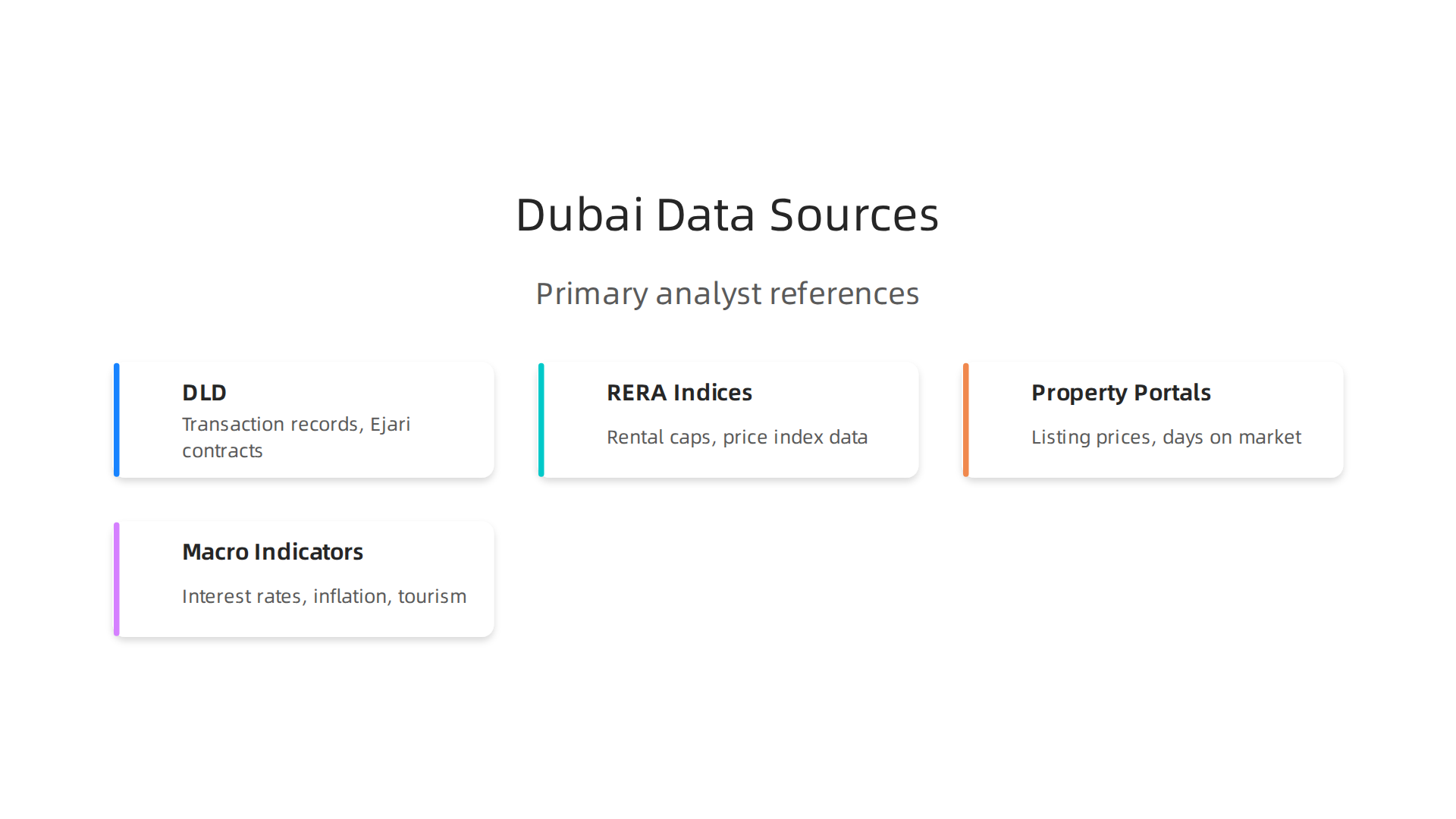
The answer is not from a single crystal ball. In Dubai, the ecosystem of real estate data sources is rich but fragmented. You need to know where to look and how to keep your data clean.
The primary source is the Dubai Land Department (DLD). Their open data portal at data.dubailand.gov.ae gives free access to transaction records, Ejari rental contracts, and property ownership data (DLD Open Data). This is the bedrock. Every recorded sale, every rental agreement, every title deed change lands here. A business analyst data analytics professional checks this portal daily to track volume and price trends.
Next come the RERA indices. The Real Estate Regulatory Authority publishes rental increase caps, price index data, and community benchmarks. These indices help you compare actual market performance against official baselines. Combine that with DLD records and you start seeing patterns.
Then you have property portals like Property Finder and Bayut. These platforms show listing prices, days on market, and supply numbers. But here is the catch: listing prices are not transaction prices. A good data analytics business analyst always cross-checks listing data against DLD recorded sales to avoid fake signals. Some tools, like DXBinteract, are built directly on DLD records and reduce that noise (DXBinteract via Propphy).
Beyond real estate, you pull in macroeconomic indicators from the Central Bank, Dubai Statistics Center, and global sources. Interest rates, inflation, tourism numbers, and population growth all affect demand. Without these, your analysis is incomplete.
For a complete rundown of where to find each dataset and what it covers, check out this detailed guide on Dubai real estate data sources.
The most important thing? Always verify data provenance and update frequency. A stale dataset can ruin your prediction. The best data for analytics comes from sources you trust and can refresh regularly.
If you want to learn how to work with these sources yourself, our free data analytics course for Dubai real estate gives you step-by-step training.
Ready to turn raw data into a winning property decision? Connect with Ayaz Salman for a free consultation today. One conversation can save you from an expensive guess.
Analyzing Market Trends and Property Cycles
You have the data sources. Now what? This is where a data analytics business analyst really earns their keep. You need to spot the patterns that tell you when to buy, when to sell, and when to wait.
History repeats itself in real estate. Dubai has clear seasonal patterns. Demand usually rises in the cooler months from October to March. Transaction volume often dips during the summer and Ramadan. A good business analyst data analytics professional studies five years of transaction data to see these cycles clearly. They look for the repeating rhythm in the Dubai housing market 2026 to time their moves better.
What indicators matter most? Here are the big three:
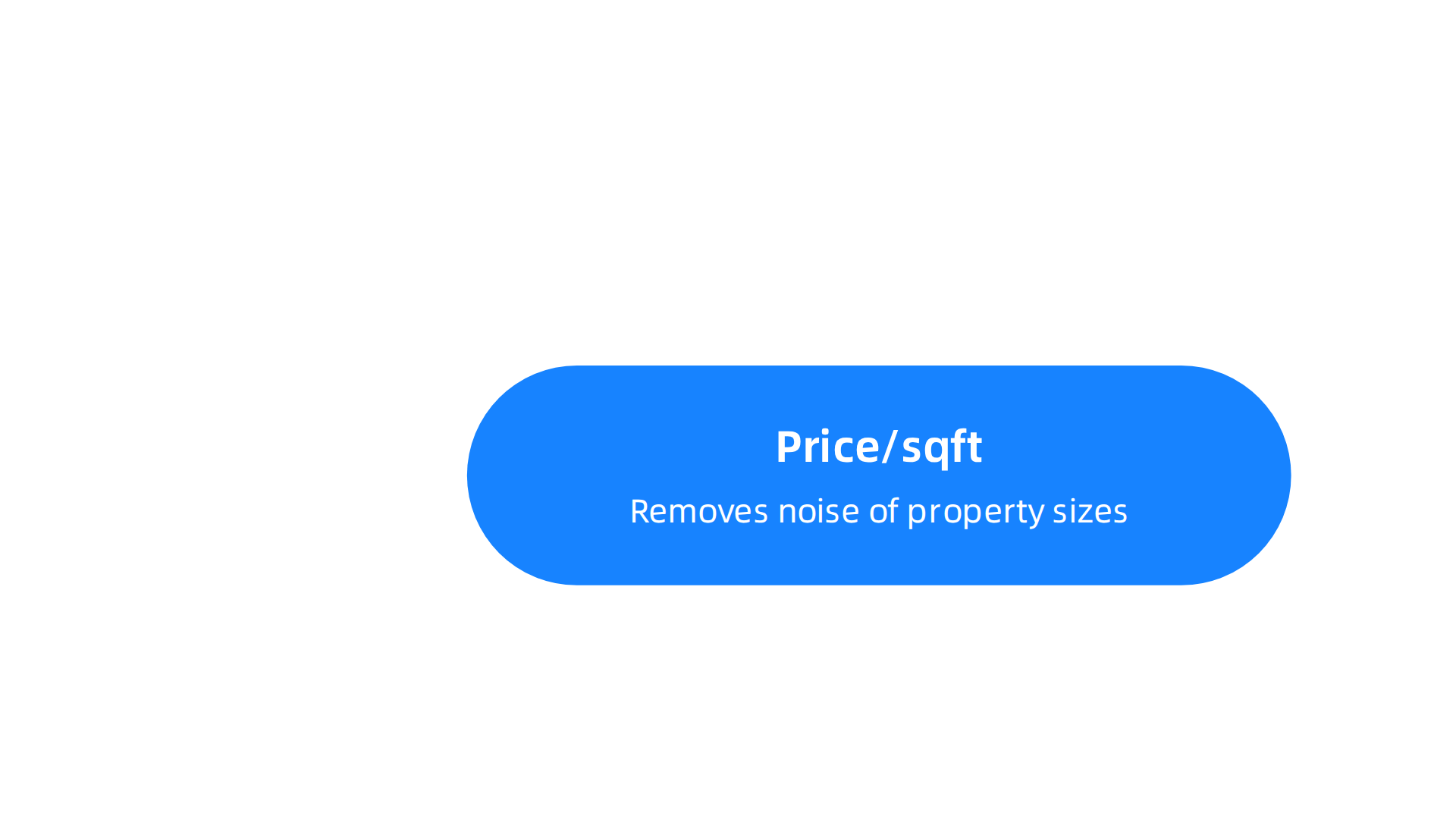
- Price per square foot. This removes the noise of different property sizes. Rising price per square foot means real demand.
- Transaction volume. High volume with stable prices shows a healthy market. Low volume with rising prices can signal a peak.
- Off-plan vs. ready property ratio. When too many buyers rush into off-plan, the market might be overheating. When ready properties dominate sales, the market is more grounded.
In early 2026, apartment prices jumped 34.77% year over year, while villa prices rose 13.60% (UAE residential property analysis 2026). A good analyst asks: is this sustainable? They check volume trends and supply numbers to find the answer.
The best tool for timing is time-series analysis. You take daily or monthly transaction prices and apply moving averages. A 50-day moving average crossing above a 200-day moving average often signals an upward trend. This is classic data for analytics work. You can track these shifts live using tools like DXBinteract’s interactive price chart.
If you want to learn these techniques step by step, check out our guide on how to earn a data analytics certificate for Dubai real estate. It walks you through the exact methods professionals use.
Ready to stop guessing and start analyzing? Take the next step. We cover more advanced cycle detection in our guide to big data analytics in Dubai real estate. And if you need a second set of eyes on your numbers, get a free consultation today. One conversation can save you months of trial and error.
Predictive Analytics for Property Valuation
What if you could run a property through a model and get its true fair value in seconds? That is exactly what predictive analytics does for real estate. It uses past data to estimate what a home or apartment is really worth based on its features.
The most common method is called a hedonic pricing model. This model breaks a property down into pieces: location, size, number of bedrooms, pool, gym, view, age, and recent sales nearby. Then it calculates how much each piece adds to the total price. Machine learning can improve this even more. Studies show that modern algorithms often beat traditional methods in accuracy (multifamily property valuation using machine learning). The key is to prepare your data for analytics correctly before training the model.
Here is where a data analytics business analyst shines. You must clean the data and build features that matter. For example, you might turn a vague location into a crime rate score or distance to the nearest metro station. You might flag units with waterfront views versus street views. Every feature you engineer helps the model learn better. A 2026 study proposed an AI tool specifically for predicting and analyzing Dubai property trends (development of a predictive tool). It uses machine learning to crunch transaction data automatically.
After the model is trained, you can use it to find undervalued assets.

Say a unit has a predicted value of AED 1.2 million but is listed at AED 900,000. That gap is your opportunity. As a business analyst data analytics professional, you can walk into a negotiation with hard evidence. The seller sees the data. They know you did your homework.
If you want to build these models yourself, our guide on big data analytics in Dubai real estate for smarter investing shows you the exact steps and tools professionals use today.
Ready to spot hidden deals with predictive models? Get a free Dubai real estate consultation and learn how to apply data science to your next investment. One smart model can save you thousands.
Unlocking Rental Market Insights with Data
So you know how to spot undervalued properties. But what if your goal is passive income? Then you need to understand the rental market just as well. That is where data analytics business analyst skills really pay off.
Rental yield, occupancy rates, and rent price trends are the three numbers that matter most to landlords and investors. A business analyst data analytics professional can track these at a granular level. You can break down a single neighborhood by building age or property type. You might find that older villas in a specific block have a higher yield than shiny new towers nearby. That is a hidden opportunity most people miss.
A 2026 study on AI in the UAE real estate industry shows exactly how powerful this kind of analysis can be (Role of AI in UAE Real Estate). It found that AI tools can process massive datasets to uncover patterns in tenant behavior and property performance. As a data analytics business analyst, you can use these insights to avoid low-demand areas before they drag down your returns.
But the real magic is predicting where rents are heading. You do that by looking at two forces: supply and demand. Supply means new handovers, the number of apartments and villas entering the market. Demand means population and employment growth. When supply outpaces demand, rents fall. When demand surges, rents rise. You can build a simple model using data for analytics to forecast these shifts months ahead.
Granular analysis combined with rent prediction gives you an edge. You might find a submarket where rents are about to increase because a new business hub is under construction. You buy now, lock in a low price, and watch your passive income grow.
To understand the broader trends shaping Dubai rental markets, check out our complete guide on big data analytics in Dubai real estate for smarter investing.
Ready to turn rental data into real income? Get a FREE Dubai Real Estate Consultation and start applying data-driven strategies to your portfolio today.
Data Visualization for Stakeholder Decision-Making
You have all those rental trends and price predictions. But raw numbers on a spreadsheet won’t convince anyone. To get a client, investor, or executive to act, you need to show them a clear story. That is what dashboards do.
A well-built dashboard turns complex data analytics into visuals anyone can understand at a glance. Instead of digging through rows of data, a stakeholder sees a map of hot neighborhoods, a line chart of rent growth, or a bar graph comparing property yields. This is where a data analytics business analyst really shines. You bridge the gap between technical analysis and real-world decisions.
So what makes a dashboard useful? The best ones focus on a handful of key performance indicators. Think price per square foot, ROI, and market comparables. These three numbers tell an investor everything they need to know about a deal. You should keep your design clean and simple. As one best practice guide puts it, favor simplicity and minimalism for chart styling (Data Visualization Best Practices for Power BI reports). That means no fancy 3D effects or cluttered labels. Just the data, done right.
Tools like Tableau and Power BI let you build interactive dashboards. A stakeholder can click a filter to see data for a specific community or property type. They can drill into the numbers without waiting for you to run a new report. This real-time interaction makes decision-making faster and more confident. The research on data for analytics in real estate shows that predictive models matter, but only if people can actually use the insights. A dashboard makes that possible.
To learn how to build these dashboards yourself, check out our guide on big data analytics in Dubai real estate for smarter investing. It walks you through the exact KPIs and tools that top investors use.
Ready to turn your data analytics into a deal-closing tool? Get a FREE Dubai Real Estate Consultation and learn how to present data that convinces every stakeholder.
Overcoming Data Challenges in Dubai Real Estate
You have a dashboard ready to go. But here is the hard truth. The data you put into it is often messy and scattered.
That is the real struggle for any data analytics business analyst working in Dubai real estate. Data comes from many places. You have the Dubai Land Department (DLD) open data portal at data.dubailand.gov.ae, which offers free transaction records, Ejari data, and rental information. You also have property portals like Bayut and Property Finder. And there are analytics platforms like DXBinteract built on top of official records.
The problem? Each source uses a different format. One might list prices in AED per square foot. Another shows total sale prices only. One updates daily. Another lags by weeks. Combining these into a single clean dataset can feel impossible.
This is where your role as a business analyst data analytics professional becomes critical. You need a strong data governance strategy. That means three things:
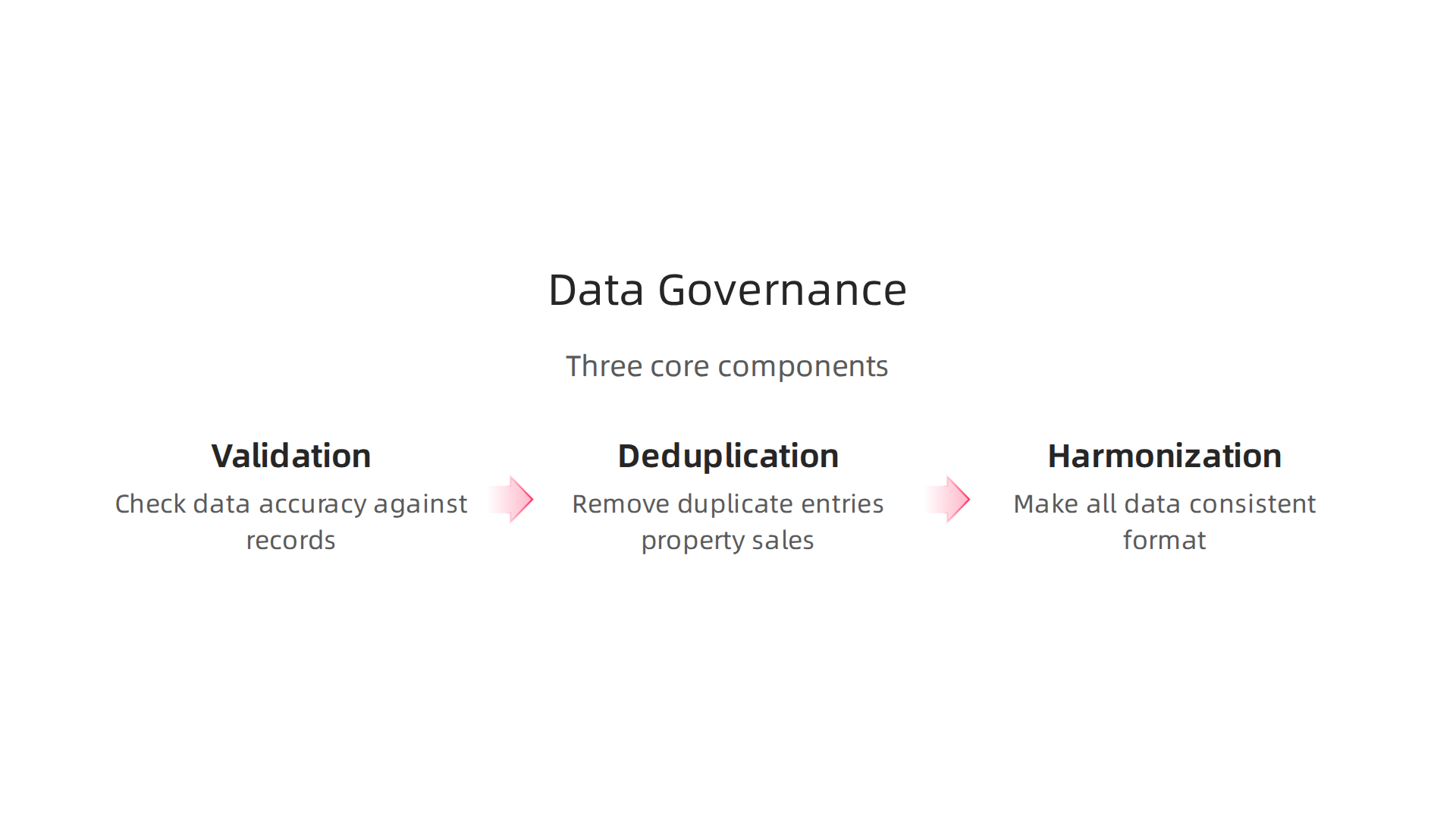
- Validation. Check if the data is accurate. Does this transaction price match the official DLD record?
- Deduplication. Remove duplicate entries. The same property sale can appear on multiple portals.
- Harmonization. Make all data consistent. Convert everything to the same currency, date format, and measurement unit.
Another big challenge is staying on top of the rules. The Real Estate Regulatory Authority (RERA) has strict rules about how you can handle transaction data. If you use public data from DLD’s open data portal, you are fine. But if you pull data from other sources, make sure you follow RERA guidelines for compliance.
The good news is that tools exist to help. Platforms like DXBinteract pull data directly from DLD records, so you get reliable, clean data without manual work. Learning how to work with these platforms is a key skill for any data analytics professional.
Want to see how top investors use clean data to find deals? Check out our guide on big data analytics in Dubai real estate for smarter investing. It shows you exactly how to source and clean data for better decisions.
Need help building a data strategy for your portfolio? Get a FREE Dubai Real Estate Consultation and learn how to turn messy market data into clear investment signals.
Building a Career as a Data-Driven Real Estate Analyst in Dubai
So you want to turn your love for numbers into a real career in Dubai real estate.

Good call. The demand for people who can combine market knowledge with technical skills is growing fast. Developers, investment firms, and even family offices all want a competitive edge through data analytics.
Just look at the job boards. Companies in Dubai are hiring data analytics business analyst roles with salaries to match. A quick search shows dozens of real estate analyst jobs open right now, many asking for 3 to 5 years of experience in analytics, data migration, or reporting. Employers want someone who can do more than just crunch numbers. They need someone who understands real estate itself.
Here is the skill trifecta that will set you apart as a business analyst data analytics professional:
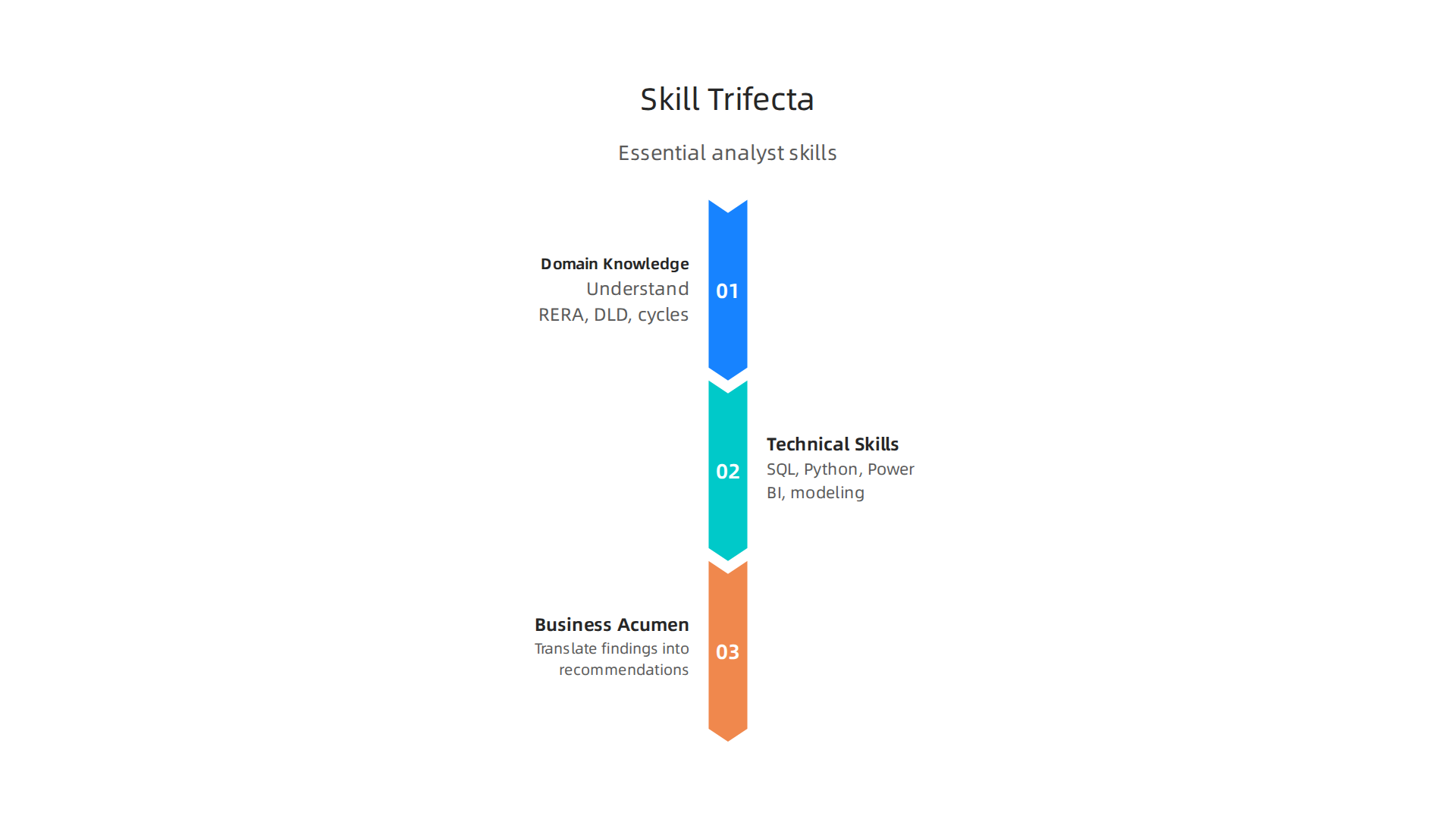
- Real estate domain knowledge. You need to know how RERA works, what DLD data means, how rental cycles move, and why location affects value. Without this, your analysis is just theory.
- Technical skills. SQL, Python, Power BI, and data modeling are not optional anymore. A job listing from Professional Pyramid specifically asks for "strong Power BI skills including DAX, data modelling" for a real estate analyst role. You also need to know how to clean and blend data from multiple sources.
- Business acumen. It is not enough to build a chart. You need to translate findings into investment recommendations. Harvard Business School says business analytics professionals must "investigate and analyze business performance" to drive decisions.
How do you build these skills? Start with data science and business analytics courses. There are many affordable options online and in Dubai. Some focus on real estate specifically, while others teach the core tools you need. Earning a certification like the CFA, CAIA, or a specialized real estate analytics credential will give you a huge boost in credibility.
If you are just starting out and are not sure which role fits you best, read our guide on entry level data analytics jobs in Dubai real estate to see the different paths you can take.
The market is ready for people who can turn data for analytics into clear answers. That could be you.
Not sure where to begin? Get a FREE Dubai Real Estate Consultation and find out how to build a career path that fits your goals.
Summary
This article explains how a data analytics business analyst turns fragmented Dubai real estate data into actionable investment decisions. It covers the core data sources you should use—like the Dubai Land Department and RERA—plus how to combine listings, transaction records and macro indicators to spot trends. You’ll learn analytical methods for timing market cycles, building hedonic and machine‑learning valuation models, and forecasting rents and yields. The guide also shows how to present findings with dashboards that persuade investors and how to overcome common data quality and governance challenges. Finally, it maps the career skills, certifications and free resources that can help you move from beginner to paid analyst in Dubai’s fast‑moving market.